
Key Differences Between Robotic and Traditional Knee Replacement
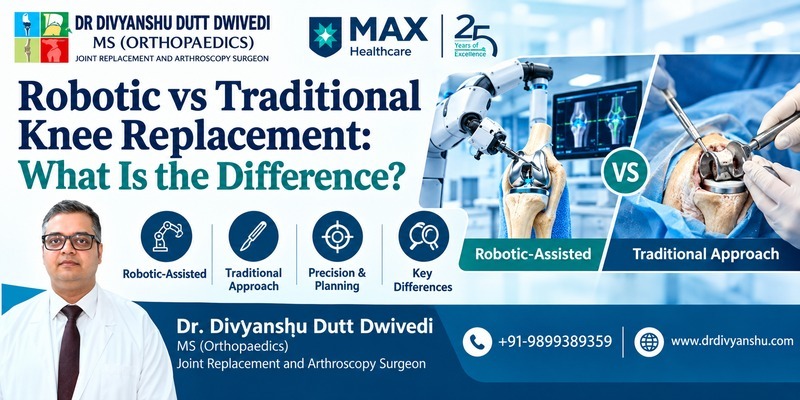
Robotic vs. traditional knee replacement is an important consideration for patients with advanced arthritis, persistent knee pain, stiffness, deformity, or difficulty walking. In Lucknow, both procedures remove damaged bone and cartilage and replace them with an artificial implant. Traditional knee replacement uses standard instruments and preoperative measurements, while robotic-assisted surgery uses computer planning and robotic guidance to support implant positioning and knee balancing. Robotic technology may improve planning and alignment in selected cases, but it does not replace the surgeon’s expertise. The best option depends on knee anatomy, deformity, ligament balance, medical history, budget, implant needs, and surgeon experience.
Robotic vs Traditional Knee Replacement: Quick Comparison
| Feature | Robotic Knee Replacement | Traditional Knee Replacement |
| Surgical planning | Computer-assisted and personalized | Conventional imaging and measurements |
| Surgical guidance | Robotic-assisted guidance | Standard surgical instruments |
| Implant positioning | Digitally planned and guided | Surgeon-guided using alignment tools |
| Bone preparation | Controlled with robotic assistance | Performed with conventional instruments |
| Surgeon involvement | Surgeon controls every major decision | Surgeon controls every major decision |
| Technology | Advanced navigation and robotic platform | Established surgical technology |
| Cost | Usually higher | Generally more affordable |
| Availability in Lucknow | Available at selected hospitals | Widely available |
| Recovery | Depends on individual factors | Depends on individual factors |
| Suitability | Useful for selected patients | Suitable for many patients |
This comparison provides general information only. Robotic surgery is not automatically better for every patient, and traditional knee replacement remains an effective treatment. The final decision should follow a detailed orthopedic assessment, including examination, X-rays, medical history, knee deformity, ligament condition, and treatment goals. Patients comparing knee replacement options in Lucknow should also ask about implant choices, rehabilitation, hospital facilities, total cost, possible risks, and the surgeon’s experience with both techniques.
What Is Traditional Knee Replacement?
Traditional knee replacement, also called conventional or manual total knee replacement, is an established procedure performed successfully for many decades. It is usually recommended when severe osteoarthritis or another joint condition causes ongoing pain, stiffness, deformity, and reduced mobility despite medicines, physiotherapy, injections, or lifestyle changes. During surgery, the orthopedic surgeon removes damaged portions of the femur and tibia and prepares the bone using conventional instruments and alignment guides. The artificial components are then positioned and secured. Traditional knee replacement is not an outdated or inferior procedure. It can provide excellent pain relief and functional improvement when appropriately planned and performed. In Lucknow, surgeon experience, implant selection, hospital care, and rehabilitation remain important factors in achieving a successful outcome.
What Is Robotic Knee Replacement?
Robotic knee replacement is a computer-assisted procedure in which technology helps the orthopedic surgeon plan and perform selected parts of knee replacement surgery. Depending on the system, imaging and digital measurements may create a detailed model of the patient’s knee. This information helps the surgeon develop a personalized plan for bone preparation, implant positioning, alignment, and soft-tissue balance. During surgery, the robotic platform provides guidance and feedback, while the surgeon controls the procedure and makes all important clinical decisions. The robot does not independently perform the operation. Robotic knee replacement in Lucknow may be considered for selected patients with advanced arthritis, deformity, unusual anatomy, or specific alignment requirements. Suitability must be confirmed during consultation.
Robotic vs. Traditional Knee Replacement: Key Differences
1. Surgical Planning
Surgical planning is one of the clearest differences between robotic and traditional knee replacement. Conventional surgery uses X-rays, physical examination, standard measurements, alignment guides, and the surgeon’s experience to plan implant positioning. Robotic-assisted surgery may use advanced imaging, computer software, and three-dimensional planning to create a more individualized surgical map. This can help the surgeon understand the patient’s bone shape, deformity, alignment, and joint space before surgery. During the operation, the plan can be reviewed and adjusted according to the actual knee condition. Robotic planning may be especially beneficial in complex anatomy, previous surgery, or significant deformity. However, the surgeon’s judgment remains essential, and technology does not eliminate the need for clinical decision-making.
2. Surgical Accuracy and Implant Alignment
Robotic knee replacement accuracy is a major reason patients in Lucknow ask about this procedure. Correct implant alignment can influence knee stability, movement, comfort, and long-term function. Robotic systems may help the surgeon perform controlled bone cuts and position implants according to a detailed preoperative plan. Research suggests that robotic-assisted surgery can reduce alignment variations compared with conventional techniques. However, improved technical accuracy does not guarantee better pain relief or satisfaction for every patient. Outcomes also depend on implant selection, ligament balance, muscle strength, rehabilitation, general health, and surgeon experience. Robotic surgery should therefore be considered a precision tool that supports the surgeon, not a guarantee of a perfect result.
3. Bone Preparation
Bone preparation involves removing damaged areas of the femur and tibia so the artificial knee components can be positioned correctly. In traditional knee replacement, the surgeon uses conventional cutting blocks, alignment rods, and surgical instruments. In robotic-assisted surgery, the robotic system can guide the surgeon according to the preoperative plan and provide real-time information about the planned bone cuts. This may help control the amount of bone removed and reduce unintended variation. The surgeon still performs the bone preparation and can modify the plan when necessary. The purpose of robotic assistance is not simply to add technology but to improve planning and control. The most suitable method depends on the patient’s anatomy and the surgeon’s assessment.
4. Implant Positioning
Correct knee implant alignment is an important part of successful knee replacement. The implant must be positioned to support comfortable movement, stability, and appropriate load distribution. Traditional surgery uses conventional alignment guides and the surgeon’s measurements to determine implant placement. Robotic-assisted surgery provides digital measurements and visual feedback that may help the surgeon position the implant according to the patient’s anatomy and planned alignment. This can be useful when the knee has a deformity or unusual bone structure. However, implant positioning is only one part of the operation. The artificial joint must also work properly with the ligaments, muscles, and surrounding soft tissues. Careful planning and experienced surgical judgment remain essential in Lucknow.
5. Soft-Tissue Balancing
Soft-tissue balancing is essential because the knee replacement must function smoothly with the surrounding ligaments and muscles. If the tissues are too tight or too loose, the patient may experience stiffness, instability, discomfort, or difficulty bending the knee. During traditional surgery, the surgeon assesses ligament tension and knee movement using clinical judgment and conventional instruments. Robotic systems may provide additional measurements while the knee is moved through different positions. This information can help the surgeon evaluate alignment and balance during the procedure. Robotic assistance does not replace the surgeon’s examination or decision-making. The final goal, whether surgery is robotic or traditional, is a stable, comfortable knee with appropriate movement and reliable implant function.
Is robotic knee replacement more precise than traditional surgery?
Current evidence suggests that robotic-assisted knee replacement can improve the accuracy and consistency of implant alignment compared with conventional techniques. Computer-based planning and robotic guidance may reduce alignment outliers and help the surgeon perform controlled bone preparation. This can be valuable in patients with significant deformity, unusual anatomy, or complex alignment requirements. However, technical accuracy does not always produce a major difference in pain relief, walking ability, or satisfaction. A successful outcome also depends on soft-tissue balancing, implant choice, surgical experience, rehabilitation, and the patient’s overall health. Patients considering robotic knee replacement in Lucknow should understand that the technology may improve precision, but it does not guarantee a perfect or superior result for everyone.
Does Robotic Knee Replacement Provide Faster Recovery?
Robotic knee replacement recovery varies from patient to patient. Some patients may benefit from accurate planning, controlled bone preparation, and appropriate soft-tissue balancing, which may support early rehabilitation. However, the robotic system alone does not determine recovery speed. Age, general health, muscle strength, body weight, arthritis severity, pain control, surgical technique, and participation in physiotherapy all influence progress. Most patients are encouraged to begin movement and assisted walking soon after surgery under medical supervision. Recovery usually continues gradually over several weeks and months. Patients in Lucknow should follow their surgeon’s exercise and wound-care instructions rather than comparing themselves with others. It is not medically accurate to promise that robotic surgery always provides faster recovery.
Is Robotic Knee Replacement Safer?
Robotic and traditional knee replacement are both major surgeries with potential risks, including infection, blood clots, bleeding, stiffness, persistent pain, nerve or blood-vessel injury, implant-related problems, and the possible need for revision surgery. Robotic technology does not eliminate these complications; its potential advantages mainly involve preoperative planning, implant alignment, and controlled surgical execution. Current studies generally show similar complication rates between robotic and conventional knee replacement for many patient groups.
Safety depends on a thorough medical evaluation, effective infection-prevention measures, blood-clot prevention, anesthesia assessment, experienced surgical care, appropriate hospital facilities, and careful postoperative monitoring. Patients considering robotic knee replacement in Lucknow should discuss their medical conditions, medications, allergies, previous surgeries, and individual risk factors with their orthopedic surgeon before selecting the most suitable surgical approach.
Does Robotic Knee Replacement Last Longer?
Modern knee implants are designed to provide long-term pain relief and mobility, and many patients use them successfully for many years. Robotic surgery may improve implant alignment in selected cases, which has led researchers to study whether it can improve long-term implant survival. However, current evidence does not justify promising that robotic knee replacement will always last longer than traditional surgery. Implant longevity depends on several factors, including implant design, positioning, bone quality, body weight, activity level, ligament balance, surgical technique, and rehabilitation. Patients in Lucknow should focus on appropriate implant selection, experienced surgery, healthy weight management, and follow-up care. Long-term results cannot be predicted by technology alone.
Robotic vs. Traditional Knee Replacement: Cost Difference
Robotic knee replacement is generally more expensive than traditional knee replacement because it may require advanced robotic equipment, computer-assisted planning, specialized staff, and additional hospital infrastructure. However, the total cost in Lucknow varies based on several factors, including the implant brand, surgical technique, hospital charges, surgeon’s fees, room category, diagnostic tests, medicines, physiotherapy, and length of hospital stay. Existing medical conditions may also increase the overall expense.
Before choosing a treatment, patients should request a detailed written estimate outlining all included services and any additional charges. Ask whether the package covers follow-up consultations, rehabilitation, medicines, investigations, and possible extended hospital stays. Online prices may not reflect the final treatment cost. An orthopedic consultation can provide a more accurate estimate after evaluating the patient’s knee condition, medical history, and overall health.
Is Robotic Knee Replacement Worth the Extra Cost?
Whether robotic knee replacement is worth the additional cost depends on the patient’s anatomy, expectations, medical needs, and financial priorities. Robotic assistance may offer detailed planning, controlled bone preparation, and improved alignment in selected cases. These advantages may be valuable for patients with complex deformity or unusual anatomy. However, the most expensive treatment is not automatically the best one. Traditional knee replacement can also provide excellent results when performed by an experienced surgeon using appropriate implants and rehabilitation. Patients in Lucknow should compare expected benefits, risks, recovery, hospital facilities, surgeon experience, and total cost. The most useful question is which approach offers the best balance of safety, function, value, and long-term suitability.
Who May Be a Good Candidate for Robotic Knee Replacement?
Robotic-assisted knee replacement may be considered for patients with advanced knee arthritis who have persistent pain, stiffness, deformity, and difficulty walking despite non-surgical treatment. Common indications include severe osteoarthritis, reduced daily activity, progressive knee deformity, and failure of medicines, injections, physiotherapy, or lifestyle changes. Robotic planning may be particularly useful when the patient has unusual anatomy, previous surgery, significant alignment problems, or specific implant-positioning requirements. However, not every patient needs robotic surgery. Suitability depends on X-rays, physical examination, ligament condition, bone quality, general health, activity level, and expectations. An orthopedic consultation in Lucknow is necessary to determine whether robotic or traditional knee replacement is appropriate.
Who May Not Need Robotic Knee Replacement?
Robotic surgery is not essential for every patient undergoing knee replacement. Traditional knee replacement remains a proven procedure and can provide excellent pain relief and mobility when performed with appropriate planning and technique. A patient may not need robotic assistance if conventional surgery is clinically suitable, the knee anatomy is straightforward, robotic technology is unavailable, or the additional cost is a concern. Some patients may also prefer a widely available treatment with an established surgical pathway. The decision should be based on medical suitability rather than advertising or the belief that newer technology is always better. Patients in Lucknow should discuss both options, including benefits, limitations, cost, recovery, and alternatives.
Does the Robot Perform the Knee Replacement?
No. The orthopedic surgeon performs the knee replacement operation. The robotic system assists with planning, measurements, navigation, and selected parts of bone preparation, depending on the technology being used. The surgeon remains responsible for evaluating the knee, selecting the implant, balancing the soft tissues, making surgical decisions, and managing unexpected findings. Robotic equipment works within the surgeon’s plan and does not independently replace the damaged joint. This distinction is important for patients considering robotic knee replacement in Lucknow. When choosing a hospital, patients should ask about the surgeon’s experience, the robotic platform available, the procedure’s expected benefits, and whether robotic assistance is genuinely appropriate for their individual knee condition.
Robotic vs. Traditional Knee Replacement: Pros and Cons
Robotic-assisted knee replacement may offer computer-based planning, detailed anatomical assessment, controlled bone preparation, and potentially improved implant alignment. Its limitations may include higher cost, limited availability, additional equipment, and the fact that technology does not guarantee better results for every patient. Traditional knee replacement offers an established technique, extensive clinical experience, wider availability, and generally lower technology-related costs. Its results depend on conventional planning, surgical instruments, implant selection, and surgeon expertise. Both procedures involve major surgery, rehabilitation, and possible complications. Patients in Lucknow should compare the advantages and limitations of each approach with their orthopedic surgeon instead of selecting a procedure solely because it is newer or more heavily advertised.
Robotic vs. Traditional Knee Replacement: Which Is Better?
Neither robotic nor traditional knee replacement is universally better. Robotic surgery may provide additional planning and alignment assistance, while traditional surgery remains effective and widely used. The best option depends on arthritis severity, knee deformity, bone quality, ligament condition, previous surgery, general health, activity level, surgeon experience, technology availability, rehabilitation support, and cost. Patients should ask whether robotic assistance is likely to provide a meaningful benefit in their specific case. They should also understand expected recovery, implant options, possible complications, and alternatives. For patients in Lucknow, an individualized consultation is more valuable than relying on general online comparisons. The right procedure is the one that safely meets the patient’s clinical needs and long-term goals.
Recovery After Knee Replacement: What Should You Expect?
Recovery after robotic or traditional knee replacement requires patience, regular exercises, and follow-up care. During the first few days, patients receive pain relief, wound care, assisted walking, and basic knee exercises. Over the following weeks, physiotherapy helps improve flexibility, muscle strength, balance, and walking ability. Many patients gradually return to daily activities, although recovery time varies based on age, overall health, muscle strength, pain control, and rehabilitation progress.
Swelling and stiffness may continue for several weeks. Patients in Lucknow should follow their surgeon’s instructions, attend physiotherapy sessions, use walking support as advised, and maintain a safe home environment. Contact the medical team promptly for fever, wound discharge, increasing redness, calf pain, or sudden breathlessness. Recovery should be judged by steady improvement rather than comparison with others.
Why Surgeon Experience Still Matters in Robotic Knee Replacement
Robotic technology is valuable, but it does not replace surgical experience. The orthopedic surgeon must interpret imaging, assess the knee, select the implant, plan alignment, balance the soft tissues, and respond to unexpected findings. An experienced joint replacement surgeon understands knee anatomy, deformity correction, implant design, surgical risks, infection prevention, and rehabilitation. These skills remain important whether the procedure is robotic or traditional. Patients considering robotic knee replacement in Lucknow should ask how frequently the surgeon performs knee replacements, whether they use robotic systems regularly, and how they manage complications. Hospital facilities, anesthesia support, nursing care, physiotherapy, and follow-up services should also be considered before making a decision.
Choosing Robotic Knee Replacement in Lucknow
Patients searching for robotic knee replacement in Lucknow should evaluate both the technology and the complete treatment team. Important questions include the surgeon’s experience with knee replacement, experience using the specific robotic system, implant options, expected benefits, possible risks, recovery plan, physiotherapy support, and total cost. Patients should also ask whether robotic surgery is medically appropriate for their knee or whether traditional replacement would provide a similar expected outcome. During consultation, the surgeon may review symptoms, physical examination findings, X-rays, deformity, ligament stability, bone quality, and general health. Choosing a hospital with experienced orthopedic, anesthesia, nursing, rehabilitation, and emergency-support teams can contribute to safer and more coordinated care.
Consult Dr. Divyanshu Dutt Dwivedi in Lucknow

Dr. Divyanshu Dutt Dwivedi is an orthopedic and joint replacement specialist associated with Max Super Speciality Hospital, Lucknow. His clinical focus includes knee replacement, robotic-assisted knee replacement, hip replacement, arthroscopy, sports injuries, and complex joint replacement procedures. Patients comparing robotic and traditional knee replacement in Lucknow can discuss their symptoms, examination findings, X-rays, treatment alternatives, implant choices, expected recovery, risks, and costs during consultation. An individualized assessment can help determine whether robotic assistance is likely to provide a meaningful benefit or whether conventional knee replacement is more suitable. To schedule a consultation or learn more about available treatment options, contact Dr. Divyanshu Dutt Dwivedi at +919899389359
Conclusion
Robotic and traditional knee replacement can both provide effective pain relief and improved mobility for people with severe knee arthritis. The key difference is that robotic-assisted surgery uses advanced planning and technology to help improve bone preparation and implant positioning, while the surgeon remains responsible for the procedure. Robotic knee replacement may offer greater precision in selected patients, but it is not automatically better for everyone. The right choice depends on your knee condition, alignment, overall health, treatment goals, and your surgeon’s experience. If you are considering robotic vs. traditional knee replacement in Lucknow, discuss both options with an experienced orthopedic and joint replacement surgeon to choose the approach best suited to your needs.
FAQs About Robotic vs. Traditional Knee Replacement
1. What is the difference between robotic and traditional knee replacement?
Robotic knee replacement uses computer-assisted planning and robotic guidance, while traditional replacement uses conventional instruments. Both procedures replace damaged knee surfaces and are performed by an orthopedic surgeon.
2. Is robotic knee replacement better than traditional knee replacement?
Robotic surgery may improve implant alignment and surgical precision, but it does not guarantee better pain relief or recovery. The best approach depends on your knee condition and the surgeon’s assessment.
3. Is robotic knee replacement more accurate?
Yes, robotic-assisted knee replacement can improve the accuracy and consistency of implant alignment. However, outcomes also depend on surgical technique, implant selection, anatomy, rehabilitation, and surgeon experience.
4. Does robotic knee replacement provide faster recovery?
Recovery after robotic knee replacement varies between patients. Technology may support precise surgery, but rehabilitation depends on age, health, muscle strength, pain management, physiotherapy, and individual recovery.
5. Is robotic knee replacement safer than traditional surgery?
Robotic assistance does not eliminate surgical risks. Both procedures can cause complications such as infection, blood clots, stiffness, or persistent pain. Proper assessment and experienced surgical care remain important.
6. Does robotic knee replacement last longer than traditional replacement?
Robotic surgery may improve implant alignment, but current evidence does not prove that every robotic replacement lasts longer. Implant longevity also depends on implant design, activity, weight, and surgical technique.
7. Is robotic knee replacement more expensive than traditional surgery?
Usually, yes. Robotic knee replacement generally costs more because of advanced technology, specialized equipment, computer-assisted planning, and hospital infrastructure. Actual costs vary between hospitals and patients in Lucknow.
8. Is robotic knee replacement worth the extra cost?
Robotic surgery may be worthwhile when improved planning and alignment offer meaningful benefits for an individual patient. However, traditional replacement can also provide excellent results when appropriately performed.
9. Who is a good candidate for robotic knee replacement?
Patients with advanced knee arthritis, persistent pain, deformity, or limited mobility may be candidates. Robotic assistance can be considered after evaluating anatomy, alignment, health, expectations, and treatment options.
10. Does a robot perform the knee replacement surgery?
No. The orthopedic surgeon performs the operation. The robotic system assists with planning, measurements, navigation, and selected surgical steps while the surgeon controls clinical decisions throughout the procedure.
11. Which is better for knee arthritis: robotic or traditional replacement?
Neither approach is universally better. The appropriate choice depends on arthritis severity, knee anatomy, deformity, surgeon expertise, technology availability, rehabilitation support, expected outcomes, and the patient’s preferences.
12. How do I choose robotic knee replacement in Lucknow?
Compare the surgeon’s knee replacement experience, robotic expertise, hospital facilities, implant options, rehabilitation support, expected benefits, risks, and total cost before choosing robotic surgery in Lucknow.
