ACL & PCL Tear Surgeon in Lucknow | Consult For Treatment
Experiencing knee pain, swelling, or instability after an injury? Get expert guidance for ACL and PCL tear treatment from Dr. Divyanshu Dutt Dwivedi. Consult an experienced orthopaedic surgeon in Lucknow to understand your condition, explore suitable treatment options, and receive a personalised treatment plan based on your knee health and recovery needs.
ACL & PCL Tear Surgeon in Lucknow | Dr. Divyanshu Dutt Dwivedi
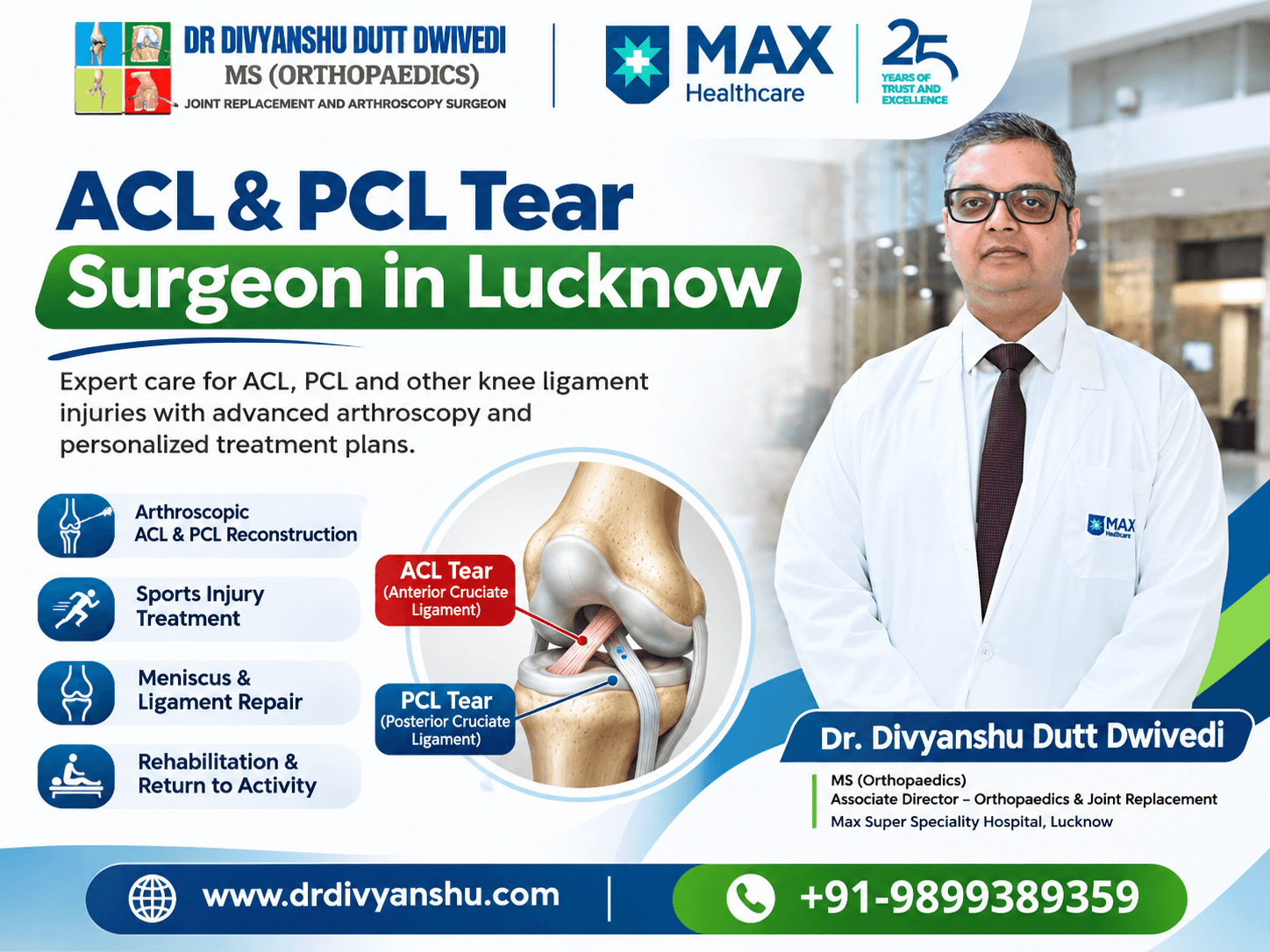
A knee ligament injury can affect walking, climbing stairs, playing sports and performing everyday activities. Sudden twisting movements, sports accidents, falls and direct impact to the knee can damage important ligaments that support the knee joint. Two of these ligaments are the Anterior Cruciate Ligament (ACL) and Posterior Cruciate Ligament (PCL).
If you are experiencing knee instability, swelling or difficulty putting weight on your leg after an injury, an orthopaedic evaluation can help identify the problem. ACL and PCL tear treatment in Lucknow depends on the type of injury, its severity, associated damage and the patient’s activity requirements.
Dr. Divyanshu Dutt Dwivedi is an orthopaedic surgeon associated with arthroscopy, sports injury treatment and joint care. Patients looking for an ACL & PCL Tear Treatment Surgeon in Lucknow can seek an assessment to understand their diagnosis and available treatment options.
What Are ACL and PCL Ligament Injuries?
The knee is a complex joint supported by bones, cartilage, muscles, tendons and ligaments. The ACL and PCL are two important ligaments located inside the knee joint. They help control the movement of the tibia (shinbone) in relation to the femur (thighbone) and contribute to knee stability.
An injury to either ligament may occur during sports, road accidents or other traumatic events. Depending on the force and direction of the injury, a ligament may be stretched, partially torn or completely ruptured.
What Is an ACL Tear?
The Anterior Cruciate Ligament, commonly called the ACL, helps prevent excessive forward movement and rotation of the tibia. It plays an important role when a person changes direction, jumps, lands or suddenly stops while running.
An ACL tear commonly occurs during activities involving sudden twisting, pivoting or an awkward landing. It may also happen after a road accident or fall.
Common signs of an ACL injury include:
- A popping sensation at the time of injury.
- Knee swelling, sometimes developing within a few hours.
- Pain and difficulty continuing physical activity.
- A feeling that the knee may give way.
- Difficulty changing direction or performing sudden movements.
The symptoms can vary. A physical examination and appropriate imaging may be needed to understand the extent of the injury.
What Is a PCL Tear?
The Posterior Cruciate Ligament, or PCL, helps prevent the tibia from moving excessively backwards in relation to the femur. It is generally stronger than the ACL, but it can still become injured after a significant impact or trauma.
A PCL tear may occur when the front of the shinbone receives a direct blow while the knee is bent. It can also happen after falling directly onto a bent knee or during certain sports injuries.
Possible symptoms include:
- Pain around the knee.
- Swelling and stiffness.
- Difficulty walking or using stairs.
- A feeling of instability.
- Discomfort while bending or putting weight on the knee.
Some PCL injuries cause less noticeable symptoms than ACL injuries. Persistent discomfort or instability after an accident should therefore be assessed by an orthopaedic specialist.
Difference Between ACL and PCL Injuries
Both ligaments contribute to knee stability, but they control different movements. The ACL limits excessive forward movement of the tibia, while the PCL helps prevent excessive backward movement.
| Feature | ACL Injury | PCL Injury |
| Full form | Anterior Cruciate Ligament | Posterior Cruciate Ligament |
| Main function | Controls forward movement and rotation | Controls backward movement |
| Common mechanism | Twisting, pivoting or sudden landing | Direct impact or fall onto a bent knee |
| Common symptoms | Swelling, instability and giving-way sensation | Pain, swelling and posterior instability |
| Treatment | Rehabilitation or reconstruction, depending on injury | Rehabilitation or reconstruction, depending on injury |
The correct treatment cannot be decided by symptoms alone. The surgeon considers the physical examination, imaging findings, knee stability and the patient’s individual needs.
Common Causes of ACL and PCL Tears
ACL and PCL injuries can affect athletes as well as people who do not participate in organised sports. The type of trauma and force applied to the knee often determine which ligament is affected.
Common causes include:
- Sports injuries: Football, basketball, badminton and other activities involving sudden direction changes can place stress on the knee.
- Sudden twisting: The foot may remain fixed while the body turns, putting pressure on the knee ligaments.
- Awkward landing: Landing with poor knee alignment after a jump may contribute to ligament injury.
- Road accidents: Direct impact to the knee, including dashboard-related injuries, can damage the PCL and other structures.
- Falls: Falling onto a bent knee or twisting the leg during a fall may injure one or more ligaments.
In some cases, ACL or PCL damage occurs along with a meniscus tear, cartilage injury or damage to other knee ligaments. Identifying these associated injuries is an important part of treatment planning.
Diagnosis of ACL and PCL Tears in Lucknow
An accurate diagnosis helps determine whether an injury can be managed with rehabilitation or requires further intervention. An orthopaedic surgeon in Lucknow may evaluate the injury through a combination of medical history, physical examination and imaging.
Orthopaedic Physical Examination
The doctor may ask how the injury happened, when the symptoms started and whether the knee feels unstable during movement. The examination may include checking swelling, tenderness, range of motion and the ability to bear weight.
Knee Stability Tests
Specific clinical tests help assess the movement and stability of the knee. These may include the Lachman test and anterior drawer test for ACL assessment, and the posterior drawer test for PCL assessment. The doctor selects tests according to the patient’s condition and comfort.
MRI Scan and Imaging
An MRI scan can help identify ligament damage and associated injuries involving the meniscus, cartilage and other soft tissues. X-rays may be advised to assess bone injuries or other structural concerns.
An MRI report should be interpreted alongside the patient’s symptoms and clinical examination. The presence of a tear on a scan does not automatically mean surgery is required.
ACL Tear Treatment in Lucknow
ACL tear treatment in Lucknow depends on the degree of ligament damage, knee stability, activity level and whether other structures are injured. Treatment may be non-surgical or surgical.
Non-Surgical ACL Treatment
Some patients may be managed without reconstruction, depending on their injury and functional requirements. A treatment plan may include:
- Activity modification during the initial recovery period.
- Appropriate pain and swelling management.
- Knee bracing, if recommended.
- Physiotherapy to improve movement and muscle strength.
- Balance and stability exercises.
- Gradual return to daily activities under professional guidance.
Rehabilitation can help improve knee function, but it may not restore normal mechanical stability in every complete ACL tear.
When Is ACL Reconstruction Considered?
An ACL reconstruction surgeon in Lucknow may discuss surgery when a patient has persistent knee instability, a complete ACL tear affecting daily or sporting activities, or associated injuries that influence knee function.
The decision is individual. Factors such as age, activity requirements, knee stability, associated meniscus damage and overall health may influence the recommendation.
Arthroscopic ACL Reconstruction
Arthroscopic ACL reconstruction is a procedure in which a surgeon uses a small camera and specialised instruments to reconstruct the damaged ligament, usually with a tendon graft.
The procedure aims to improve knee stability and support functional recovery. The graft type, surgical approach and rehabilitation plan depend on the patient’s condition and the surgeon’s assessment.
PCL Tear Treatment in Lucknow
PCL tear treatment in Lucknow also depends on the severity of the injury and whether other knee structures are damaged. Many isolated PCL injuries can be managed without surgery, while more severe injuries may require reconstruction.
Non-Surgical PCL Treatment
For selected isolated PCL injuries, a doctor may recommend a structured rehabilitation programme. This can involve activity modification, a suitable knee brace and exercises designed to improve quadriceps strength and knee control.
The rehabilitation plan should be supervised by an appropriate healthcare professional. Returning to demanding activities too early may increase discomfort or instability.
When Is PCL Reconstruction Considered?
PCL reconstruction surgery may be considered in patients with significant instability, severe ligament damage, combined ligament injuries or persistent functional problems despite appropriate non-surgical management.
A detailed assessment helps determine whether reconstruction is suitable. The surgeon also evaluates associated meniscus, cartilage and other ligament injuries before recommending a procedure.
Arthroscopic PCL Reconstruction
Arthroscopic PCL reconstruction involves reconstructing the damaged ligament using a graft and specialised surgical techniques. The procedure is planned according to the pattern of injury and the patient’s knee condition.
Surgery is not automatically required for every PCL tear. The treatment decision should be based on a complete clinical assessment.
Combined ACL and PCL Tear Treatment
In some serious knee injuries, both cruciate ligaments may be damaged at the same time. These are known as combined ACL and PCL injuries or multi-ligament knee injuries.
Such injuries can occur after high-impact trauma, road accidents or severe sports-related incidents. Other structures, including collateral ligaments, meniscus and cartilage, may also be affected.
Combined ACL PCL injury treatment requires a detailed evaluation of knee stability, associated injuries and the overall condition of the joint.
Depending on the findings, the treatment plan may involve:
- Initial management of pain, swelling and associated injuries.
- Detailed clinical and imaging assessment.
- Rehabilitation or bracing where appropriate.
- Surgical planning for selected multi-ligament injuries.
- A structured rehabilitation programme after treatment.
The timing and type of surgery vary from patient to patient. Complex injuries should be assessed by an orthopaedic surgeon experienced in knee ligament and sports injury management.
Recovery and Physiotherapy After ACL or PCL Treatment
Rehabilitation is an important part of recovery after both surgical and non-surgical ligament treatment. The programme is designed according to the injury, treatment method, healing progress and patient’s functional goals.
After reconstruction, physiotherapy may focus on reducing swelling, gradually restoring knee movement, improving muscle strength and developing balance and coordination.
Recovery generally involves different stages:
- Early recovery: Focus on swelling management, safe movement and following weight-bearing instructions.
- Movement and strength: Gradually improve knee range of motion and strengthen the muscles around the joint.
- Functional rehabilitation: Work on balance, coordination, walking and controlled activity.
- Return to activity: Progress towards work, exercise or sports only after appropriate clinical assessment.
There is no single recovery timeline that applies to everyone. Returning to sports should depend on strength, knee stability, functional testing and the treating surgeon’s advice rather than a fixed date.
Why Consult Dr. Divyanshu Dutt Dwivedi for ACL and PCL Treatment in Lucknow?
Dr. Divyanshu Dutt Dwivedi is an orthopaedic surgeon associated with Max Super Speciality Hospital, Lucknow, where he is listed as Associate Director – Orthopaedics and Joint Replacement. His training includes an MS in Orthopaedics from University College of Medical Sciences and GTB Hospital, Delhi, and a fellowship in Arthroscopy and Sports Injury from Sant Parmanand Hospital, New Delhi. His professional profile includes knee arthroscopy and the management of ACL, PCL and meniscus-related conditions. Patients can discuss their symptoms, imaging reports and treatment concerns with him to understand the appropriate next steps for their knee injury.
ACL and PCL Surgery Cost in Lucknow
The ACL reconstruction cost in Lucknow and PCL reconstruction cost in Lucknow can vary according to the procedure and individual treatment requirements. A combined ligament injury may involve a different surgical plan from an isolated ACL or PCL tear.
Factors that may influence the overall cost include:
- Type and complexity of the ligament injury.
- Whether one or multiple ligaments require treatment.
- Surgical technique and graft requirements.
- Hospital and operating theatre charges.
- Implants, investigations and medicines.
- Length of hospital stay, if required.
- Physiotherapy and follow-up consultations.
For an accurate estimate, patients should discuss their diagnosis and treatment plan with the hospital. A written estimate can help clarify which services are included and whether rehabilitation or follow-up costs are separate.
Book a Consultation for ACL and PCL Tear Treatment in Lucknow
Knee pain, swelling or instability after an injury should not be ignored, particularly when symptoms affect walking, work or sports. An early orthopaedic assessment can help identify the injured structures and clarify suitable treatment options.
If you are looking for an ACL Tear Surgeon in Lucknow, PCL Tear Surgeon in Lucknow or an orthopaedic specialist for a combined knee ligament injury, you can contact Dr. Divyanshu Dutt Dwivedi for consultation.
Doctor: Dr. Divyanshu Dutt Dwivedi
Hospital: Max Super Speciality Hospital, Lucknow
Contact number: +91-9899389359
Call to discuss an appointment and bring any previous MRI scans, X-rays or medical reports to your consultation.
FAQs About ACL & PCL Tear Surgeon in Lucknow
- Who treats ACL and PCL tears in Lucknow?
Dr. Divyanshu Dutt Dwivedi is an orthopaedic surgeon in Lucknow whose professional profile includes knee arthroscopy and ACL/PCL-related treatment.
- When should I consult an ACL tear surgeon in Lucknow?
Consult an orthopaedic surgeon if knee swelling, instability, pain or difficulty walking continues after an injury, particularly following a twisting movement or accident.
- Can an ACL tear heal without surgery in Lucknow?
Some ACL injuries can be managed with rehabilitation, depending on tear severity, knee stability, activity requirements and associated damage. An examination helps determine suitable treatment.
- Does every PCL tear require surgery in Lucknow?
No. Many isolated PCL injuries can be treated without surgery. Reconstruction may be considered for severe instability, combined injuries or persistent functional problems.
- How is an ACL tear diagnosed in Lucknow?
An orthopaedic assessment may include a medical history, knee stability tests and MRI imaging to evaluate ligament damage and associated meniscus or cartilage injuries.
- What is the difference between ACL and PCL reconstruction?
ACL reconstruction restores the ligament controlling forward tibial movement, while PCL reconstruction addresses excessive backward tibial movement. Both use individualised surgical planning.
- How long does ACL reconstruction recovery take in Lucknow?
Recovery varies with the graft, associated injuries, rehabilitation progress and activity goals. Return to sports requires clinical assessment and functional testing.
- What is the ACL and PCL surgery cost in Lucknow?
The cost depends on injury complexity, surgical requirements, graft, hospital charges and rehabilitation. A personalised estimate is available after clinical assessment.
- Can ACL and PCL tears happen together?
Yes. Severe trauma can damage both cruciate ligaments and other knee structures. Such injuries require detailed assessment and an individualised treatment plan.
Experiencing Knee Pain or Instability? Get Expert ACL & PCL Treatment in Lucknow
Don’t let a knee ligament injury affect your everyday activities. Consult Dr. Divyanshu Dutt Dwivedi to understand your ACL or PCL injury and explore suitable treatment options based on your condition.

Dr. Divyanshu Dutt Dwivedi is a well-known orthopedic surgeon in Lucknow, recognized for his expertise in treating a variety of musculoskeletal conditions. He is known as one of the Best Orthopedic Doctors in Lucknow.