Tennis Elbow Treatment in Lucknow – Expert Orthopedic Care for Elbow Pain
Experiencing persistent elbow pain, stiffness, or difficulty performing everyday activities? Get expert care for tennis elbow from Dr. Divyanshu Dutt Dwivedi. Consult an experienced orthopaedic surgeon in Lucknow to understand your condition, explore suitable treatment options, and receive a personalized treatment plan based on your needs.
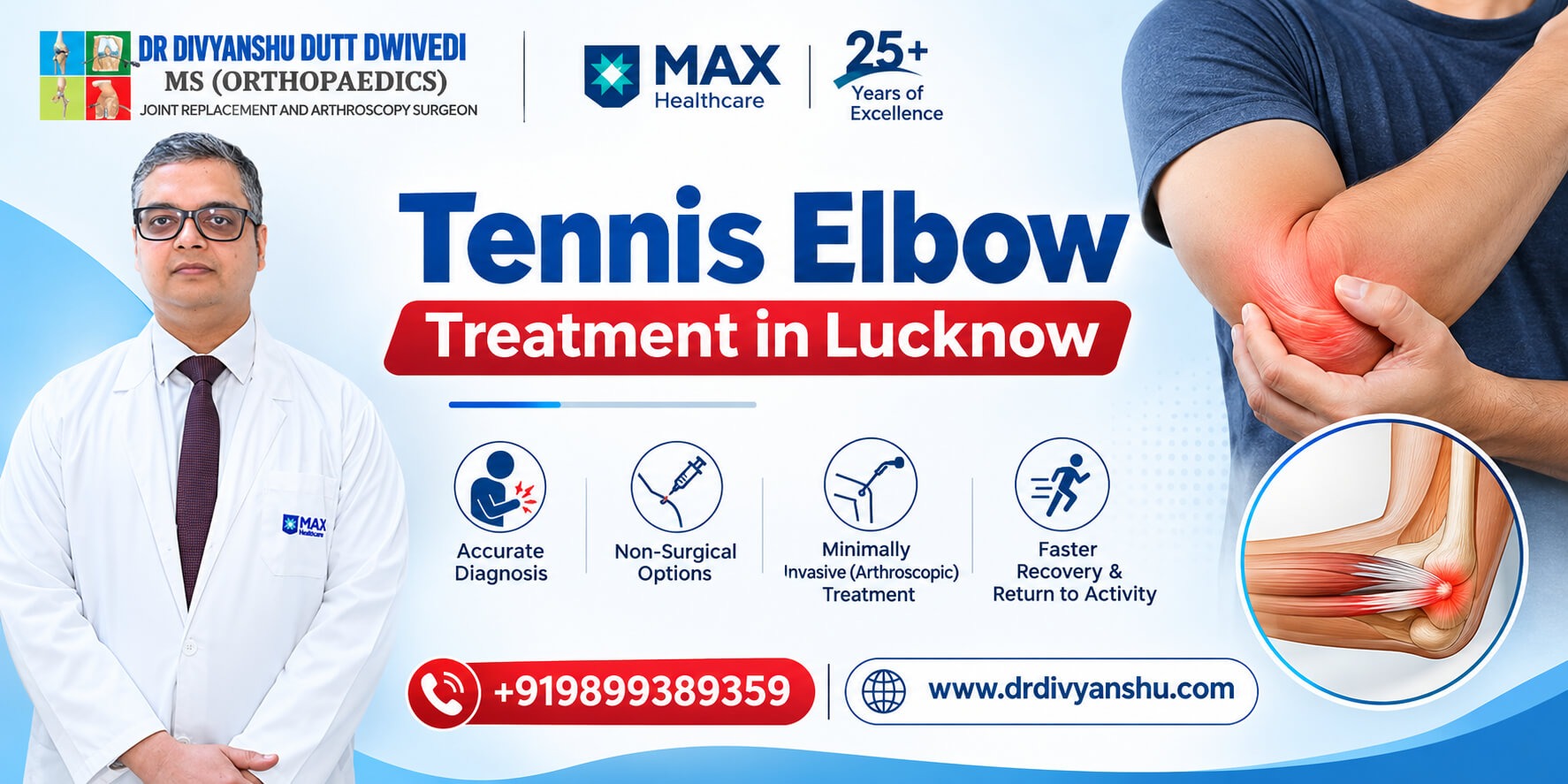
Tennis Elow Treatment Specialist in Lucknow | Dr. Divyanshu Dutt Dwivedi
Consult Dr. Divyanshu Dutt Dwivedi, Orthopedic Surgeon, Shoulder, Elbow, and Sports Injury Specialist.
Experiencing pain on the outer side of your elbow while lifting objects, gripping things, or performing everyday activities? You may be experiencing tennis elbow, a common tendon condition also known as lateral epicondylitis.
Dr. Divyanshu Dutt Dwivedi provides orthopedic consultation and personalized treatment planning for patients experiencing tennis elbow and other elbow-related conditions in Lucknow.
With specialized fellowship training in shoulder and elbow surgery, arthroscopy, and sports injury management, Dr. Divyanshu focuses on accurate diagnosis and appropriate treatment approaches, including physiotherapy-based rehabilitation and non-surgical management.
Whether you are experiencing recent elbow discomfort or persistent tennis elbow pain, an orthopedic evaluation can help identify the underlying problem and guide your recovery.
Book an Orthopedic Consultation in Lucknow
Call: +91-9899389359
What Is the Best Treatment for Tennis Elbow in Lucknow?
Tennis elbow is generally treated through activity modification, physiotherapy, progressive strengthening exercises, and appropriate pain management. The right treatment depends on symptom severity, tendon condition, and individual patient requirements.
Dr. Divyanshu Dutt Dwivedi provides orthopedic evaluation to help patients understand the cause of elbow pain and select an appropriate treatment plan.
Non-surgical management is usually considered initially. Further specialist assessment may be recommended if symptoms persist despite appropriate conservative treatment.
What Is Tennis Elbow (Lateral Epicondylitis)?
Tennis elbow, medically known as lateral epicondylitis or lateral elbow tendinopathy, is a condition that causes pain around the outer part of the elbow.
It affects the tendons that connect the forearm muscles to the lateral epicondyle, the bony prominence on the outside of the elbow.
The extensor carpi radialis brevis (ECRB) tendon is commonly involved. This tendon helps extend the wrist and supports gripping activities.
Repeated wrist movements, forceful gripping, and excessive loading of the forearm muscles can contribute to tendon-related changes and pain.
Despite its name, tennis elbow does not only affect tennis players. Office workers, athletes, laborers, fitness enthusiasts, and people performing repetitive manual activities can also develop this condition.
What Are the Common Symptoms of Tennis Elbow?
Tennis elbow commonly causes pain and tenderness around the outer side of the elbow, particularly during gripping, lifting, and wrist movements.
Common symptoms include:
- Pain or tenderness over the outer elbow.
- Discomfort while lifting bottles, bags, or other objects.
- Weakness when gripping or holding objects.
- Pain while shaking hands.
- Discomfort when extending the wrist against resistance.
- Forearm pain that may extend towards the wrist.
- Difficulty performing repetitive hand and arm activities.
Symptoms may initially appear during physical activities but can gradually interfere with everyday tasks.
If elbow pain continues or affects your grip strength, consult an orthopedic specialist for assessment.
What Causes Tennis Elbow?
Tennis elbow generally develops due to repeated mechanical stress on the wrist extensor tendons attached to the outer elbow.
Common contributing factors include:
Repetitive Hand and Wrist Movements
Frequent wrist extension, gripping, twisting, and lifting can increase the load on the forearm tendons.
Sports and Fitness Activities
Tennis, badminton, weightlifting, and other activities involving repetitive gripping may contribute to tennis elbow.
Occupational Activities
People who regularly use tools, operate machinery, perform manual work, or carry out repetitive computer-related tasks may experience increased tendon loading.
Improper Lifting Techniques
Lifting heavy objects with an awkward wrist position or excessive forearm loading may aggravate tendon symptoms.
Sudden Increase in Physical Activity
Increasing exercise intensity or physical workload without adequate conditioning may contribute to elbow tendon problems.
Understanding the underlying cause helps develop an appropriate tennis elbow treatment and rehabilitation plan.
How Is Tennis Elbow Diagnosed?
Tennis elbow is primarily diagnosed through medical history and physical examination.
An orthopedic specialist evaluates the location of pain, symptom duration, grip strength, wrist movements, and tenderness around the outer elbow.
The assessment may include:
1. Medical History
The doctor reviews previous injuries, sports activities, occupational movements, and daily activities that aggravate symptoms.
2. Physical Examination
The elbow, wrist, and forearm are examined to identify tenderness, movement limitations, and pain during specific activities.
3. Clinical Tests
Specific examination techniques may include:
- Cozen’s test
- Mill’s test
- Maudsley’s test
These tests help assess the affected wrist extensor tendons.
4. Imaging Tests
X-rays, ultrasound, or MRI may be recommended when the diagnosis is uncertain or another elbow condition is suspected.
Imaging is not routinely required for every patient.
An accurate diagnosis helps distinguish tennis elbow from other causes of elbow pain and guides the treatment approach.
What Are the Treatment Options for Tennis Elbow?
Tennis elbow treatment depends on the patient’s symptoms, duration of pain, functional limitations, and clinical findings.
Most patients initially receive non-surgical management.
1. Activity Modification
Reducing repetitive gripping, heavy lifting, and movements that aggravate elbow pain can help manage excessive tendon loading.
The goal is to modify painful activities while maintaining appropriate movement and function.
2. Physiotherapy and Rehabilitation
Physiotherapy is an important part of tennis elbow management.
A personalized rehabilitation program may include:
- Wrist extensor strengthening.
- Controlled eccentric exercises.
- Forearm stretching.
- Grip strengthening.
- Progressive resistance exercises.
- Functional rehabilitation.
Exercises should be selected and progressed according to the patient’s condition and tolerance.
3. Pain Management
A doctor may recommend suitable medication for short-term pain management after considering the patient’s medical history and other health requirements.
4. Elbow Braces and Supports
Some patients may benefit from a forearm counterforce brace or wrist support during activities that aggravate symptoms.
The suitability of a brace depends on individual assessment.
5. Further Specialist Assessment
Patients with persistent or severe symptoms may require additional evaluation to review the diagnosis and determine whether further treatment is necessary.
Injections and surgical procedures are not appropriate for everyone and should only be considered after discussing their evidence, potential benefits, and risks.
Tennis Elbow Treatment Without Surgery
Many people with tennis elbow improve without surgery.
Non-surgical tennis elbow treatment focuses on reducing excessive tendon loading, improving forearm strength, and gradually restoring normal arm function.
A conservative treatment program may include:
- Activity modification.
- Physiotherapy.
- Wrist extensor strengthening.
- Stretching exercises.
- Appropriate pain management.
- Gradual return to work and sports activities.
Physiotherapy-based rehabilitation helps improve the strength and functional capacity of the affected forearm muscles.
The duration of treatment varies depending on the severity and duration of symptoms and the patient’s response to rehabilitation.
Dr. Divyanshu Dutt Dwivedi provides orthopedic evaluation and guidance regarding suitable non-surgical treatment options for tennis elbow in Lucknow.
Tennis Elbow Physiotherapy and Rehabilitation
Physiotherapy helps patients improve movement, strength, and functional ability when dealing with tennis elbow.
The rehabilitation program is planned according to the patient’s symptoms, physical activity requirements, and clinical assessment.
Wrist Extensor Strengthening
Progressive strengthening exercises help improve the capacity of muscles involved in wrist extension.
Eccentric Exercises
Eccentric exercises involve controlled lengthening of the wrist extensor muscles under resistance and may be incorporated into a rehabilitation program.
Forearm Stretching
Appropriate stretching exercises can help improve flexibility and movement tolerance.
Grip Strengthening
Gradual grip-strengthening exercises help improve the ability to hold and carry objects.
Functional Rehabilitation
Patients gradually progress towards normal work, sports, and daily activities as their symptoms and functional capacity improve.
A physiotherapy program should be individualized rather than following the same exercise routine for every patient.
When Should You Consult an Orthopedic Doctor for Tennis Elbow?
You should consider orthopedic consultation when:
- Elbow pain continues despite modifying activities.
- Pain affects your ability to grip or lift objects.
- Symptoms repeatedly return.
- You experience persistent forearm discomfort.
- Elbow pain interferes with your work or sports activities.
- You have difficulty performing everyday movements.
Pain following a significant injury, severe swelling, redness, fever, or marked restriction of movement requires prompt medical evaluation.
Early assessment can help identify the cause of symptoms and prevent inappropriate self-treatment.
When Is Surgery Required for Tennis Elbow?
Surgery is not usually the first treatment option for tennis elbow.
Most patients are initially managed with activity modification and physiotherapy-based rehabilitation.
Surgical evaluation may be considered in selected patients with persistent symptoms despite an appropriate period of conservative management.
Depending on the clinical findings, procedures may involve removing damaged tendon tissue or addressing the affected tendon attachment.
Dr. Divyanshu Dutt Dwivedi has specialized fellowship training in shoulder and elbow surgery and arthroscopy. He can assess persistent elbow conditions and discuss appropriate treatment options, including whether further surgical evaluation is warranted.
Surgery should only be considered after an individualized assessment and discussion of its potential benefits, risks, and limitations.
How Long Does Tennis Elbow Take to Recover?
Tennis elbow recovery time varies depending on the duration of symptoms, severity of tendon involvement, physical activities, and response to treatment.
Some patients improve over several weeks, while others may require several months of rehabilitation.
Factors that influence recovery include
- Severity and duration of symptoms.
- Repetitive occupational or sports activities.
- Consistency with rehabilitation.
- Appropriate activity modification.
- Overall physical health.
- Individual response to treatment.
Gradually increasing activity and following professional rehabilitation guidance can help support recovery.
Tennis Elbow vs Golfer’s Elbow: What Is the Difference?
Tennis elbow and golfer’s elbow are two different tendon conditions affecting opposite sides of the elbow.
|
Feature |
Tennis Elbow |
Golfer’s Elbow |
|
Medical name |
Lateral epicondylitis |
Medial epicondylitis |
|
Pain location |
Outer elbow |
Inner elbow |
|
Tendons involved |
Wrist extensor tendons |
Wrist flexor and pronator tendons |
|
Common symptoms |
Pain during gripping and wrist extension |
Pain during gripping and wrist flexion |
|
Common management |
Activity modification and rehabilitation |
Activity modification and rehabilitation |
Both conditions can develop due to repetitive loading and may require orthopedic assessment and physiotherapy.
Why Consult Dr. Divyanshu Dutt Dwivedi for Tennis Elbow Treatment in Lucknow?
Choosing an orthopedic surgeon with relevant training in shoulder, elbow, and sports injury management is important when dealing with persistent elbow pain.
Dr. Divyanshu Dutt Dwivedi is an orthopedic surgeon practicing in Lucknow, with professional training and experience in joint replacement, arthroscopy, sports injury management, and shoulder and elbow surgery.
His professional background includes:
- MBBS from Kasturba Medical College, Manipal.
- MS in Orthopaedics.
- Fellowship training in joint replacement surgery.
- Fellowship training in arthroscopy and sports injury management.
- International fellowship training in shoulder and elbow surgery at Myongji Hospital, South Korea.
- Fellowship training in revision hip and knee arthroplasty at Helios Endo-Klinik, Hamburg, Germany.
His approach emphasizes appropriate diagnosis, understanding the patient’s functional requirements, and selecting a suitable treatment plan.
Patients experiencing tennis elbow, outer elbow pain, or related sports injuries can consult him for orthopedic evaluation and treatment guidance.
Book Your Consultation for Tennis Elbow Treatment in Lucknow
Persistent elbow pain can affect your ability to work, exercise, lift objects, and perform everyday activities.
Get an orthopedic evaluation to understand the cause of your elbow pain and explore appropriate treatment options.
Consult Dr. Divyanshu Dutt Dwivedi for tennis elbow, lateral epicondylitis, and sports-related elbow conditions in Lucknow.
Dr. Divyanshu Dutt Dwivedi
Orthopedic Surgeon | Arthroscopy | Sports Injury | Shoulder and Elbow Surgery
Consultation Address:
S9, 2nd Floor, OPD Wing, Max Super Speciality Hospital, Hahnemann Chauraha Road, Viraj Khand, Gomti Nagar, Lucknow, Uttar Pradesh 226010, India.
Phone: +91-9899389359
Consultation Hours: Monday to Saturday, 9:00 AM – 5:00 PM.
Call Now: +91-9899389359
Frequently Asked Questions About Tennis Elbow Treatment in Lucknow
- Which doctor treats tennis elbow in Lucknow?
An orthopedic surgeon experienced in elbow conditions and sports injuries can evaluate and manage tennis elbow. Dr. Divyanshu Dutt Dwivedi provides orthopedic consultations in Gomti Nagar, Lucknow.
- Can tennis elbow heal without surgery?
Yes. Many patients improve with conservative management, including activity modification, physiotherapy, and progressive strengthening exercises.
- What is the best treatment for tennis elbow?
The appropriate treatment depends on symptom severity and clinical findings. Activity modification and physiotherapy are important initial treatment approaches for many patients.
- Is physiotherapy effective for tennis elbow?
Physiotherapy can help improve forearm strength, movement, and functional capacity. A personalized program may include stretching, eccentric exercises, and progressive strengthening.
- How long does tennis elbow take to heal?
Recovery may take several weeks to months depending on symptom severity, duration, and response to rehabilitation.
- Can tennis elbow cause wrist pain?
Yes. Pain may extend from the outer elbow into the forearm, particularly during gripping and wrist movements.
- Is tennis elbow caused only by playing tennis?
No. Tennis elbow can affect people who perform repetitive gripping, lifting, wrist extension, or manual activities, even if they do not play tennis.
- Can I exercise with tennis elbow?
Some exercises may be appropriate, but activities that significantly aggravate symptoms should be modified. A physiotherapist or orthopedic specialist can guide a gradual return to exercise.
- Is PRP injection necessary for tennis elbow?
No. PRP injection is not necessary for every patient. Its effectiveness remains uncertain, and potential benefits and limitations should be discussed with a specialist.
- When does tennis elbow require surgery?
Surgical assessment may be considered when symptoms persist despite appropriate conservative treatment and continue to cause significant functional limitations.
- What is the difference between tennis elbow and golfer’s elbow?
Tennis elbow causes pain on the outer side of the elbow, while golfer’s elbow affects the inner side. Both conditions involve tendon-related problems.
- Where can I consult a tennis elbow specialist in Lucknow?
Dr. Divyanshu Dutt Dwivedi consults at Max Super Speciality Hospital, Gomti Nagar, Lucknow. Contact +91-9899389359 to inquire about appointments.
Get Expert Tennis Elbow Treatment in Lucknow
Don’t let elbow pain affect your daily activities. Consult Dr. Divyanshu Dutt Dwivedi for expert evaluation and personalized treatment options for tennis elbow and related elbow conditions.

Dr. Divyanshu Dutt Dwivedi is a well-known orthopedic surgeon in Lucknow, recognized for his expertise in treating a variety of musculoskeletal conditions. He is known as one of the Best Orthopedic Doctors in Lucknow.