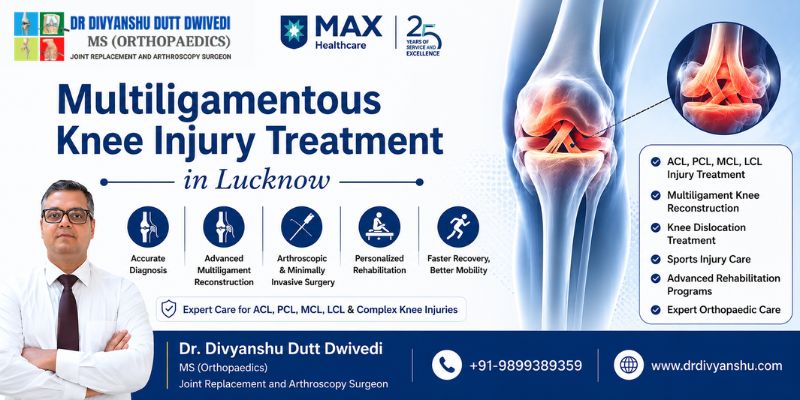
A multiligamentous knee injury is a complex condition where two or more major knee ligaments are damaged due to severe trauma, sports injuries, or accidents. These injuries can affect knee stability, movement, and overall quality of life if not treated properly. For patients looking for multiligamentous knee injury treatment in Lucknow, advanced diagnosis and personalized treatment planning are essential. Dr. Divyanshu Dutt Dwivedi provides specialized care for complex knee injuries, including ligament reconstruction and rehabilitation support. With modern techniques and patient-focused treatment, the goal is to restore knee stability, improve mobility, and help patients return to their daily activities safely.
Meet Dr. Divyanshu Dutt Dwivedi – Multiligamentous Knee Injury in Lucknow
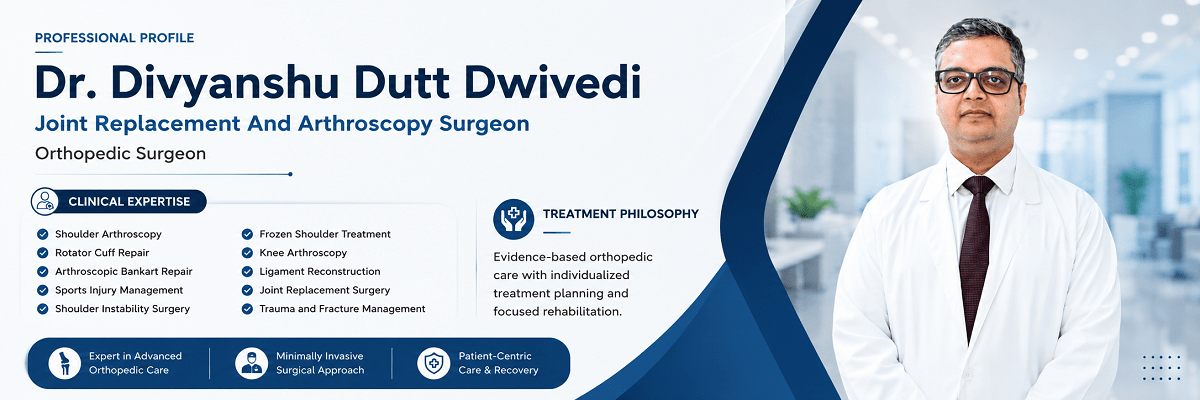
Dr. Divyanshu Dutt Dwivedi is a trusted orthopedic surgeon dedicated to providing advanced care for complex bone, joint, and sports injuries. With expertise in treating multiligamentous knee injuries, he focuses on accurate diagnosis, evidence-based treatment, and personalized rehabilitation to help patients regain mobility and return to an active lifestyle. Using modern surgical techniques, including arthroscopic and minimally invasive procedures, he aims to restore knee stability, reduce pain, and improve long-term joint function. Patients seeking multiligamentous knee injury treatment in Lucknow receive comprehensive care tailored to their condition, lifestyle, and recovery goals.
Clinical Expertise
- Multiligamentous Knee Injury Treatment
- ACL Reconstruction Surgery
- PCL Reconstruction Surgery
- Complex Knee Ligament Reconstruction
- Knee Arthroscopy & Sports Injury Surgery
- Meniscus Repair & Cartilage Preservation
- Robotic Knee Replacement Surgery
- Total & Partial Knee Replacement
- Hip Replacement Surgery
- Shoulder Arthroscopy & Rotator Cuff Repair
- Complex Trauma & Fracture Management
- Minimally Invasive Orthopedic Surgery
What is a Multiligamentous Knee Injury?
A multiligamentous knee injury refers to damage involving two or more important stabilizing ligaments of the knee joint. Unlike a single ligament tear, this condition affects the overall stability and function of the knee. The injury commonly involves the Anterior Cruciate Ligament (ACL), Posterior Cruciate Ligament (PCL), Medial Collateral Ligament (MCL), Lateral Collateral Ligament (LCL), or the Posterolateral Corner (PLC) structures.
The knee depends on these ligaments to maintain proper alignment and control movement. When multiple ligaments are injured, patients may experience severe instability, difficulty walking, swelling, and a feeling that the knee may give way. A proper evaluation by an experienced multiligament knee injury surgeon in Lucknow is important for accurate diagnosis and effective treatment planning.
Causes of Multiligamentous Knee Injury
A multiligamentous knee injury usually occurs due to high-energy trauma that places excessive force on the knee joint. These injuries are more severe compared to isolated ligament tears because multiple supporting structures can be damaged at the same time.
Common causes include:
| Cause | How It Affects the Knee |
| Road accidents | Sudden impact can cause knee dislocation and multiple ligament tears |
| Sports injuries | Contact sports like football, cricket, and basketball may damage several ligaments |
| Falls from height | High-force landing can disrupt knee stability |
| Severe twisting injuries | Extreme rotation can injure ACL, PCL, MCL, and LCL together |
A knee dislocation injury is one of the major causes associated with multiligament damage. In such cases, immediate medical evaluation is important because nearby nerves and blood vessels may also be affected. Early assessment helps prevent long-term complications and improves the chances of successful recovery.
Types of Multiligament Knee Injuries
The pattern of a multiple knee ligament tear can vary depending on the force, direction, and severity of the trauma. Doctors classify these injuries according to the number of ligaments involved and the structures affected.
Common injury patterns include:
| Injury Pattern | Description |
| ACL + PCL Injury | Damage to the two major central stabilizing ligaments |
| ACL + MCL Injury | Combined injury affecting front and inner knee stability |
| PCL + LCL Injury | Can lead to significant rotational instability |
| ACL + PCL + PLC Injury | A complex injury requiring specialized reconstruction |
| Complete Multiligament Injury | Multiple ligament disruption with severe instability |
Patients with combined ligament injuries often require advanced imaging and detailed treatment planning. An experienced knee ligament reconstruction surgeon in Lucknow evaluates the injury pattern before deciding whether ligament repair, reconstruction, or staged treatment is required.
Symptoms of Multiple Knee Ligament Injury
The symptoms of a multiligamentous knee injury can be more severe than a single ligament tear because several stabilizing structures are affected. Many patients experience immediate pain and difficulty using the affected leg after an accident or sports injury.
Common symptoms include:
- Severe knee pain after trauma
- Rapid swelling around the knee joint
- Feeling of knee instability or giving way
- Difficulty standing or walking
- Limited range of knee movement
- Bruising around the injured area
- A feeling that the knee is loose or unstable
- Reduced confidence while putting weight on the leg
In some cases, patients may ignore symptoms after the initial injury, especially if pain reduces over time. However, untreated ligament instability can lead to repeated knee problems, cartilage damage, and early joint degeneration. Consulting a sports injury specialist in Lucknow helps identify the severity of the injury and the most suitable treatment approach.
Diagnosis of Multiligamentous Knee Injury
Accurate diagnosis is the foundation of successful multiligamentous knee injury treatment in Lucknow. Since multiple structures may be involved, doctors perform a detailed assessment to understand the exact damage and create an effective treatment plan.
The diagnosis usually includes:
Physical Examination
A specialist checks knee stability, movement limitations, swelling, and ligament function through specific clinical tests. These examinations help identify which ligaments may be injured.
MRI Knee Scan
An MRI knee scan provides detailed images of soft tissues, including the ACL, PCL, MCL, LCL, and PLC. It helps determine the severity of ligament damage and whether additional structures like cartilage or meniscus are affected.
X-Ray and Other Imaging Tests
X-rays help evaluate bone injuries, fractures, or knee alignment issues associated with trauma. In suspected knee dislocation cases, additional assessments may be required to check blood circulation and nerve function.
A complete diagnosis allows an expert ACL/PCL reconstruction surgeon in Lucknow to select the most appropriate treatment strategy based on injury severity, patient goals, and overall knee condition.
Treatment Options for Multiligamentous Knee Injury
The treatment approach for a multiligamentous knee injury depends on several factors, including the number of damaged ligaments, injury severity, patient age, activity level, and overall knee condition. A detailed evaluation helps an orthopedic specialist decide whether conservative care or surgical intervention is more suitable.
For patients searching for multiligamentous knee injury treatment in Lucknow, the primary goal of treatment is to restore knee stability, improve movement, reduce pain, and prevent future joint problems. Treatment is customized according to the injury pattern because every multiligament injury is different.
The major treatment options include:
| Treatment Approach | Purpose |
| Non-surgical management | Suitable for selected cases with partial tears or lower instability |
| Ligament repair | Repairs damaged ligament tissues when healing potential exists |
| Ligament reconstruction | Replaces severely damaged ligaments using grafts |
| Rehabilitation therapy | Restores strength, flexibility, and knee function |
Early treatment planning by an experienced multiligament knee injury surgeon in Lucknow can significantly improve recovery outcomes and help patients regain confidence in their knee function.
Non-Surgical Treatment for Multiligamentous Knee Injury
Not every multiple knee ligament tear requires immediate surgery. In selected cases where ligament damage is incomplete or knee stability is maintained, non-surgical treatment may be considered. This approach focuses on reducing symptoms and improving knee strength through structured rehabilitation.
Non-surgical treatment may include the following:
- Activity modification to avoid stress on the knee
- Knee braces for additional support
- Pain management as advised by a specialist
- Physiotherapy exercises to improve strength and mobility
- Gradual return to normal activities
However, conservative treatment may not provide adequate stability for patients with complete ligament rupture, severe knee instability, or combined ACL, PCL, MCL, and LCL injury treatment requirements.
Patients involved in sports or physically demanding activities often require a more advanced approach to restore proper knee mechanics. A detailed consultation with a knee ligament reconstruction surgeon in Lucknow helps determine whether non-surgical care is appropriate or if surgical reconstruction is needed.
Surgical Treatment for Multiligamentous Knee Injury
Surgery is often recommended for patients with significant ligament damage, knee instability, or combined ligament tears affecting daily activities. The objective of complex knee reconstruction surgery is to restore the natural stability of the knee and allow controlled movement.
During surgery, damaged ligaments may be repaired or reconstructed depending on their condition. Reconstruction involves replacing the damaged ligament with a graft, which may be obtained from the patient’s own body or selected donor sources.
Common surgical procedures include:
- ACL reconstruction for anterior knee instability
- PCL reconstruction for posterior instability
- MCL or LCL reconstruction for side-to-side stability problems
- Posterolateral Corner (PLC) Reconstruction for rotational instability
The timing and sequence of surgery depend on injury complexity. Some patients may require single-stage reconstruction, while others may benefit from staged procedures to achieve better healing and functional outcomes.
An experienced PCL/ACL reconstruction surgeon in Lucknow carefully evaluates each case before recommending the most suitable surgical approach.
Advanced Multiligament Knee Reconstruction Surgery
Modern multiligament knee reconstruction focuses on restoring the original anatomy and function of the knee as much as possible. Advanced surgical techniques allow specialists to address complex injuries with better precision and improved rehabilitation planning.
During reconstruction, surgeons consider:
- Number of ligaments injured
- Degree of knee instability
- Condition of surrounding tissues
- Patient’s lifestyle and activity requirements
- Associated injuries such as meniscus or cartilage damage
Advanced procedures may involve:
Arthroscopic Knee Surgery
Arthroscopic knee surgery uses small incisions and a camera-assisted technique to visualize and treat internal knee structures. This approach may help reduce tissue damage and support smoother recovery in appropriate cases.
Graft Selection
The choice of graft plays an important role in ligament reconstruction. Depending on the injury pattern, surgeons may use the following:
- Hamstring tendon graft
- Patellar tendon graft
- Quadriceps tendon graft
- Other suitable graft options
Single-Stage Reconstruction
In some cases, multiple injured ligaments can be reconstructed during one surgery. This approach may help restore stability earlier when the injury pattern allows it.
Staged Reconstruction
For highly complex injuries with significant swelling, stiffness, or additional complications, treatment may be performed in stages to improve outcomes.
Choosing an experienced specialist for knee ligament surgery in Lucknow ensures that treatment decisions are based on detailed assessment rather than a standard approach.
Recovery After Multiligament Knee Surgery
Recovery after multiligamentous knee injury treatment requires patience, commitment, and a structured rehabilitation program. Since multiple ligaments are involved, healing usually takes longer compared to isolated ACL or PCL injuries.
The recovery process generally includes:
| Recovery Phase | Focus Area |
| Early phase | Pain control, swelling reduction, and protected knee movement |
| Intermediate phase | Improving flexibility, muscle activation, and knee strength |
| Advanced rehabilitation | Functional training and return to daily activities |
| Sports rehabilitation | Gradual return to high-demand activities |
During the initial weeks, patients may require braces, walking support, and controlled exercises. Physiotherapy plays an important role in restoring range of motion, muscle strength, and knee confidence.
A successful outcome depends on several factors, including:
- Severity of ligament injury
- Surgical technique
- Patient cooperation
- Rehabilitation consistency
- Overall health condition
Following the recommended rehabilitation plan helps patients achieve better stability and reduces the risk of future knee problems.
Recovery Timeline After Multiligament Knee Reconstruction
The recovery period varies from patient to patient because every injury pattern is unique. Generally, recovery after complex knee reconstruction surgery follows a gradual progression.
First 6 Weeks
The focus is on:
- Protecting reconstructed ligaments
- Managing swelling and pain
- Improving controlled knee movement
- Maintaining muscle activity
6 to 12 Weeks
Patients usually begin with:
- Strengthening exercises
- Improved walking patterns
- Increased knee mobility training
3 to 6 Months
The rehabilitation program focuses on:
- Functional movements
- Balance training
- Strength improvement
- Better knee coordination
9 to 12 Months and Beyond
A return to sports or high-impact activities depends on
- Knee stability
- Muscle strength
- Functional assessment
- Doctor’s recommendation
A gradual approach is important because returning too quickly may increase stress on healing ligaments.
Cost of Multiligamentous Knee Injury Surgery in Lucknow
The cost of multiligamentous knee injury treatment in Lucknow varies depending on multiple factors. Since these injuries involve different combinations of ligament damage, treatment expenses are customized according to the complexity of each case.
Factors affecting treatment cost include:
| Factor | Impact on Cost |
| Number of damaged ligaments | More complex injuries may require advanced procedures |
| Type of reconstruction required | Different surgical techniques influence overall expenses |
| Graft selection | Graft source and requirement may affect cost |
| Hospital facilities | Infrastructure and surgical support services contribute |
| Rehabilitation requirements | Long-term physiotherapy affects overall recovery expenses |
Patients should focus on receiving an appropriate diagnosis and quality treatment rather than choosing care only based on cost. A proper evaluation helps create a treatment plan that balances safety, effectiveness, and long-term knee function.
Why Choose Dr. Divyanshu for Multiligamentous Knee Injury Treatment in Lucknow?
Dr. Divyanshu Dutt Dwivedi provides specialized orthopedic care for patients dealing with complex knee ligament injuries, sports-related trauma, and instability problems. As an experienced orthopedic specialist, he focuses on accurate diagnosis, personalized treatment planning, and advanced surgical techniques when required. Patients looking for a multiligament knee injury surgeon in Lucknow can benefit from a comprehensive approach that includes evaluation, treatment guidance, and rehabilitation support. His expertise covers complex ligament conditions involving the ACL, PCL, MCL, LCL, and other supporting knee structures. The treatment philosophy focuses on restoring knee stability, improving mobility, and helping patients return to their normal lifestyle with confidence.
Advanced Multiligamentous Knee Injury Treatment in Lucknow
A multiligamentous knee injury requires specialized evaluation and advanced treatment to restore knee stability and function. If you are experiencing knee instability, pain, or difficulty walking after a major injury, consulting an experienced specialist is important. Dr. Divyanshu Dutt Dwivedi provides expert multiligamentous knee injury treatment in Lucknow, including advanced ligament reconstruction, arthroscopic procedures, and personalized rehabilitation plans. With proper diagnosis and timely care, patients can improve mobility and return to their daily activities with confidence. For expert consultation regarding ACL, PCL, MCL, and LCL ligament injuries, contact Dr. Divyanshu Dutt Dwivedi at +91-9899389359.
FAQs About Multiligamentous Knee Injury Treatment in Lucknow
- What is a multiligamentous knee injury?
A multiligamentous knee injury occurs when two or more knee ligaments, such as the ACL, PCL, MCL, or LCL, are torn. It requires prompt diagnosis and specialized treatment to restore knee stability.
- Who provides the best multiligamentous knee injury treatment in Lucknow?
Patients seeking multiligamentous knee injury treatment in Lucknow should consult an experienced orthopedic surgeon specializing in ligament reconstruction, sports injuries, and advanced arthroscopic knee surgery for comprehensive care.
- Does every multiligament knee injury require surgery?
No. Partial tears with stable knees may respond to non-surgical treatment, while complete ligament injuries, knee dislocations, or severe instability often require knee ligament reconstruction surgery.
- How is a multiligamentous knee injury diagnosed?
Diagnosis includes a physical examination, MRI scan, X-rays, and knee stability tests to identify injured ligaments and determine the most appropriate treatment for complex knee injuries.
- How long does recovery take after multiligament knee reconstruction?
Recovery usually takes 9 to 12 months, depending on injury severity, reconstructed ligaments, rehabilitation progress, and the patient’s overall health and commitment to physiotherapy.
- Can I walk after multiligament knee surgery?
Most patients gradually begin walking with support under medical supervision. Weight-bearing depends on the reconstructed ligaments, surgical technique, and rehabilitation protocol recommended by the orthopedic surgeon.
- What are the symptoms of a multiligamentous knee injury?
Common symptoms include severe knee pain, swelling, instability, limited movement, difficulty walking, and a feeling that the knee gives way after trauma or a sports-related injury.
- Can multiple knee ligament tears heal without surgery?
Some partial ligament injuries may heal with bracing and physiotherapy. However, complete tears causing instability generally require multiligament knee reconstruction for better long-term knee function.
- What causes a multiligamentous knee injury?
High-impact road accidents, sports injuries, falls from height, and knee dislocations are the most common causes of multiple knee ligament injuries, often affecting the ACL, PCL, MCL, and LCL.
- How much does multiligamentous knee injury treatment cost in Lucknow?
Treatment costs vary depending on the number of injured ligaments, surgical complexity, graft selection, hospital facilities, and rehabilitation requirements. A consultation provides an individualized treatment estimate.
- Can I return to sports after multiligament knee reconstruction?
Yes. Many patients return to sports after completing rehabilitation, restoring knee strength, stability, and flexibility. Clearance depends on functional recovery and the surgeon’s clinical assessment.
